How can modern leaders shift from a performance-only focus to a human-centric approach that addresses the pervasive impact of trauma in the workplace and builds organizational resilience? I explore some answers to this question in my 3-article series on Trauma-Informed Leadership.

Mark Hennick
Leadership
For decades, the prevailing corporate wisdom suggested that employees should "leave their personal problems at the door" before beginning the workday. However, emerging research indicates that trauma is not a marginal issue but a widespread public health epidemic that profoundly shapes workplace behaviors, interpersonal interactions, and overall organizational health.
As we navigate an era marked by global pandemics, economic volatility, and systemic inequities, leaders are discovering that their teams are often operating from a place of "syndemic trauma.", Understanding this "Invisible Elephant" in the room is no longer just a clinical necessity; it is a strategic imperative for any organization that hopes to thrive in an increasingly complex world.
The Prevalence of the Unseen
Trauma is a silent yet powerful force that is far more common than many leaders realize. Global studies indicate that approximately 70.4% of individuals have experienced at least one traumatic event in their lifetime, with many carrying the weight of multiple exposures. In the United States specifically, some estimates suggest this number is as high as 90%. These experiences, ranging from childhood adversity and domestic violence to racial trauma and the collective stress of a global pandemic, do not simply vanish when an employee logs into a meeting. Instead, they manifest as hypervigilance, emotional dysregulation, and cognitive impairments that can be easily misinterpreted as performance or attitude issues.
The Science of Stress: Amygdala vs. Prefrontal Cortex
To lead effectively, one must understand the neurobiology of the "wounded workforce." Trauma fundamentally alters the brain’s stress response system. In individuals with a history of trauma, the amygdala, the brain’s threat detector, becomes hyperactive, keeping the person in a constant state of fear or anxiety.
Simultaneously, the prefrontal cortex, which is responsible for rational decision-making and planning, is weakened under extreme stress. This shift pushes employees outside their "window of tolerance," leading to fight-or-flight reactions (hyperarousal) such as aggression and conflict, or freeze-and-fawn responses (hypoarousal) such as disengagement and emotional numbing. Traditional leadership models that rely on high-pressure metrics often inadvertently exacerbate these biological threat responses, leading to burnout and high turnover.
The Paradigm Shift: From "What is Wrong" to "What Happened"
Trauma-Informed Leadership (TIL) represents a fundamental shift in management theory. It shifts the organizational stance from the interrogative, "What is wrong with you?" to a compassionate inquiry, "What happened to you?" This does not mean leaders assume the role of therapists; rather, it requires a heightened attunement to the relational and environmental factors that shape human behavior. By recognizing that "hurt people hurt people," leaders can implement practices that stabilize the nervous system, allowing employees to access the higher-order thinking needed for innovation and collaboration.
The Four Rs of Trauma-Informed Leadership
Based on the standardized framework developed by SAMHSA, leaders can begin this transformation by adopting the Four Rs:
Realize: Understand the widespread impact of trauma and the potential paths for recovery.
Recognize: Learn to identify the signs and symptoms of trauma in staff, families, and even oneself.
Respond: Fully integrate this knowledge into policies, procedures, and everyday interactions.
Resist: Actively work to prevent re-traumatization by fostering an environment of transparency and psychological safety.
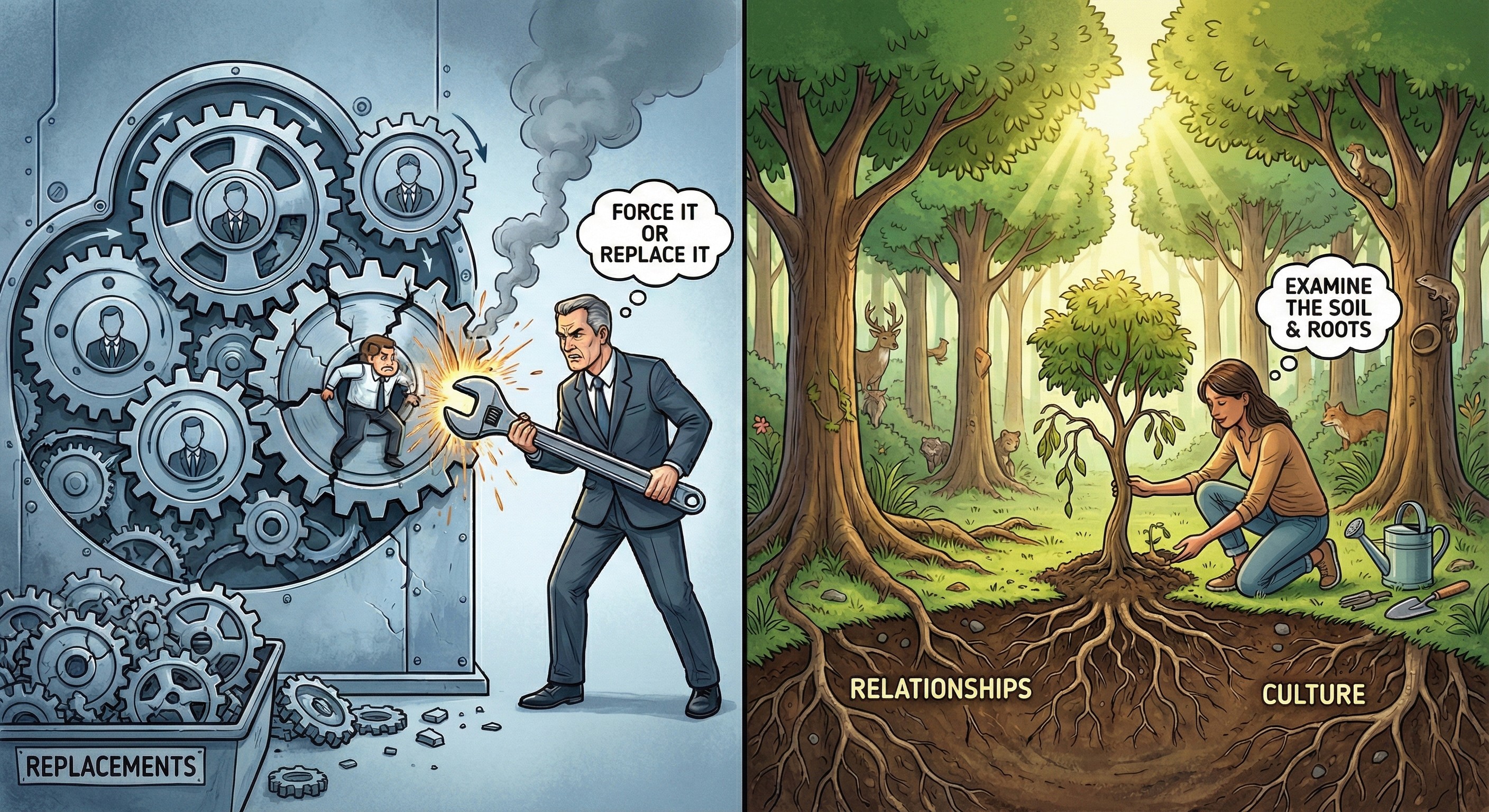
Think of a traditional organization like a mechanical clock; when a gear (employee) is damaged, the manager simply tries to force it to turn or replace it. However, a trauma-informed organization is like a living forest; the leader understands that if one tree is struggling, they must examine the soil (culture) and root system (relationships) to ensure the health of the entire ecosystem.
Adopting a trauma-informed lens is not about lowering standards; it is about creating the neurobiological safety necessary for people to rise to those standards. When we acknowledge the invisible elephant in our workplaces, we move from being trauma-organized to trauma-resilient, ensuring that our organizations build rather than break the human bonds that hold them together.
References:
Elisseou, S. Shamaskin-Garroway, A. Kopstick, A. J. Potter, J. Weil, A. Gundacker, C. & Moreland-Capuia, A. (2024). Leading organizations from burnout to trauma-informed resilience: A vital paradigm shift. The Permanente Journal, 28(1), 198–205. https://doi.org/10.7812/TPP/23.110
Harris, S. R. Amano, A. Winget, M. Skeff, K. M. & Brown-Johnson, C. G. (2024). Trauma-informed healthcare leadership? Evidence and opportunities from interviews with leaders during COVID-19. BMC Health Services Research, 24(1), 515. https://doi.org/10.1186/s12913-024-10946-9
Lloyd, R. C. (2024). Trauma-informed leadership: Integrating research-based leadership theories and SAMHSA principles for building resilient teams. 2024 Regent Research Roundtables Proceedings, 288-303
Substance Abuse and Mental Health Services Administration. (2014). SAMHSA’s concept of trauma and guidance for a trauma-informed approach. (HHS Publication No. SMA 14-4884)
Wyatt, Z. (2025). Trauma-informed leadership: Recognising, responding, and rebuilding organisational resilience. Neurology and Neuroscience, 6(3), 1-6. https://doi.org/10.33425/2692-7918.1089
