How can organizations move from aspirational data alignment to real, measurable business outcomes? Here we examine how a well-executed, business-aligned data strategy, rooted in governance, architecture, and the right metrics, turns data into a driver of transformation, trust, and sustained value.

Mark Hennick
Leadership
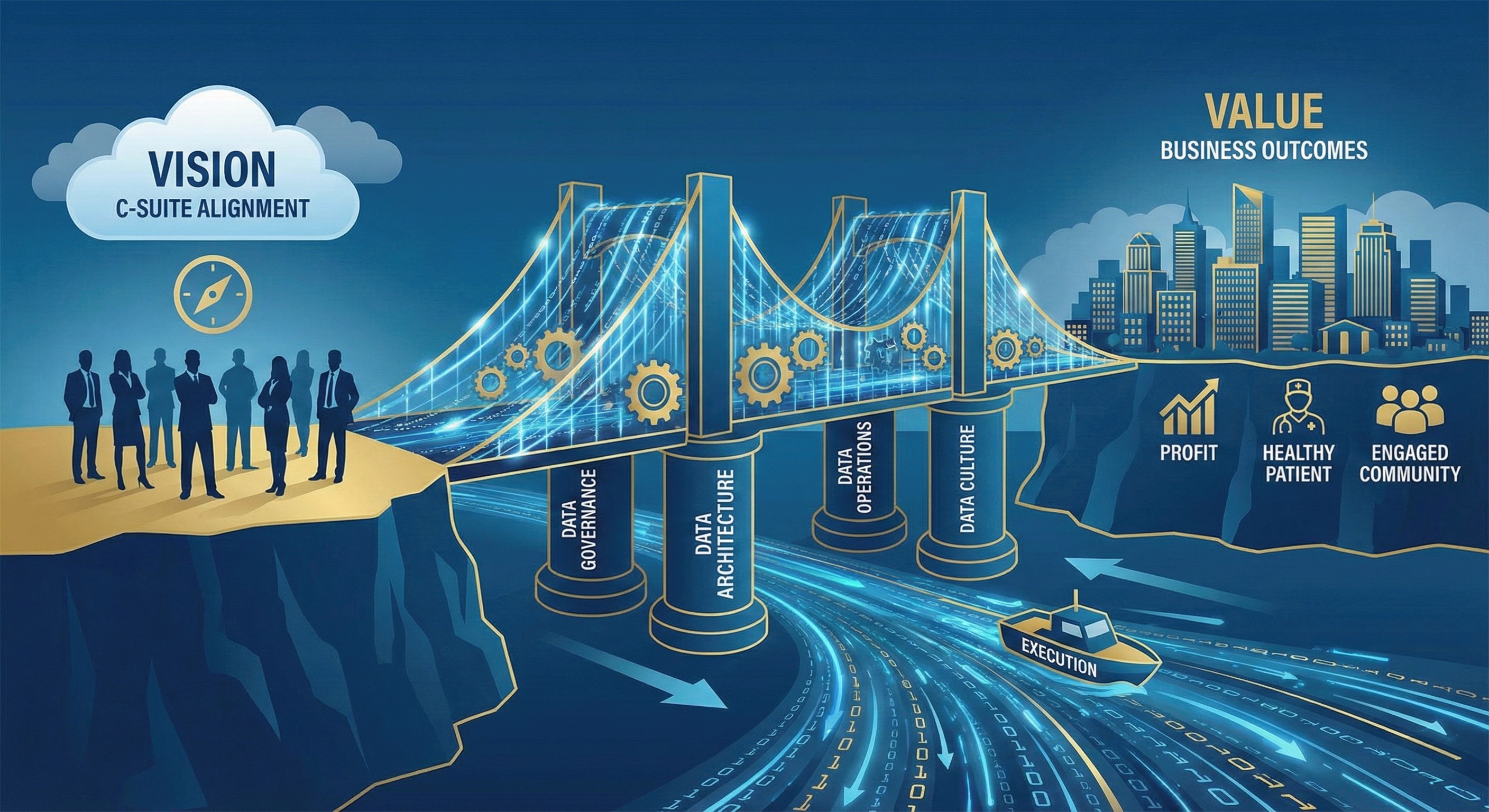
Moving from Alignment to Execution
In our previous post, we explored the critical cultural and strategic gap that often exists between IT departments and executive leadership. We identified that bridging this divide is essential for survival in the modern digital economy. But how do organizations move from high-level alignment to tangible execution?
The answer lies in architecting a comprehensive, business-aligned Data Strategy. A robust data strategy serves as the shared language of the modern enterprise. It translates technical specifications into business outcomes like profit margins, patient recovery rates, and donor engagement levels. This post details how to build that strategy, focusing on governance, architecture, and the metrics that matter.
Defining the Data Strategy Ecosystem
A data strategy is frequently misunderstood as a document that lives on a server, referenced only during audits. In reality, a successful data strategy is a dynamic, living roadmap that aligns data management practices with business objectives. It answers the fundamental question: How will we use data to win?.
A comprehensive data strategy is an ecosystem composed of four interconnected pillars:
Data Governance: The policies, roles, and responsibilities that ensure data accuracy, security, and compliance.
Data Architecture: The technical infrastructure that supports data flow and storage.
Data Operations: The processes that ensure data is delivered to the right people at the right time.
Data Culture: The organizational mindset that prioritizes evidence-based decision-making over intuition.
When these pillars are aligned, data strategy acts as the connective tissue between IT capabilities and the C-suite's goals.
Governance: The Foundation of Trust
Data governance is often misconstrued by business leaders as bureaucratic red tape. In reality, effective governance is the mechanism that generates trust. Without governance, data is a liability prone to errors, breaches, and misuse. With governance, data becomes an asset.
For CEOs concerned with reputational risk and regulatory compliance, governance provides necessary guardrails. However, the paradigm is shifting from a "command and control" model to an "enablement" model.
Feature | Traditional Governance | Modern Adaptive Governance |
|---|---|---|
Primary Goal | Compliance and Restriction | Value Creation and Enablement |
Access Model | "Need to know" (Restrictive) | "Right to know" (Democratized) |
Decision Making | Centralized IT mandate | Federated Business/IT Council |
Data Quality | Fixed periodically (Reactive) | Continuous monitoring (Proactive) |
Perception | "The Department of No" | "The Department of How" |
Effective governance involves defining clear ownership and establishing single sources of truth for critical metrics. If the Marketing department defines "customer churn" differently than the Sales department, the resulting data discrepancies will erode trust. A unified data governance framework resolves these conflicts, ensuring the CEO receives a consistent picture of organizational health.
Case Study: Vesta's Data-Driven Turnaround
The transformation of Vesta, a Maryland-based behavioral health non-profit, serves as a paramount example of how data strategy drives organizational change. Under the leadership of President and CEO Jignesh Dalal, who possesses a dual background in finance and IT, Vesta moved from reactive operations to predictive service delivery.
Vesta implemented a hybrid server system and business intelligence tools to create a robust data backbone. This allowed for centralized data management while maintaining the security required for sensitive health information. Crucially, they utilized predictive analytics. Instead of merely counting services delivered, Vesta used data to predict patient risks. Clinicians received alerts for clients at high risk of hospitalization, allowing for proactive intervention. This shift improved patient outcomes and saved significant costs for the healthcare system, proving that even organizations with limited resources can achieve profound transformation by aligning their data strategy with their mission.
Case Study: Mayo Clinic's Platform Approach
On the other end of the spectrum, the Mayo Clinic's partnership with Google Cloud illustrates how large-scale data strategy drives innovation. Mayo Clinic recognized that to maintain its status as a global leader, it needed to unlock the insights trapped within its massive data repositories.
Mayo moved from a pipeline business model to a platform model. To address privacy concerns, they utilized a data enclave approach. Instead of sending data out to researchers, which incurs risk, researchers bring their algorithms to the data. This Federated Learning model satisfied the CEO's need for security while meeting the CTO's need for innovation. This alignment allowed Mayo Clinic to monetize its data assets safely and accelerate the pace of medical discovery.
Metrics That Matter: Defining Success
To prove the value of data strategy, organizations must move beyond operational IT metrics like uptime to strategic business KPIs. The Board of Directors cares about how IT contributes to the bottom line.17 The table below demonstrates how to translate typical IT metrics into strategic business outcomes.
IT Metric (Technical) | Business Outcome (Strategic) | CEO/Board Narrative |
|---|---|---|
System Uptime (99.9%) | Business Continuity | "We ensured 24/7 revenue generation capabilities, preventing $50k/hour in potential downtime losses." |
Ticket Resolution Time | Employee Productivity | "We recovered 5,000 hours of billable staff time by automating support for routine issues." |
Data Quality (95% accuracy) | Decision Confidence | "We eliminated 15% of marketing spend waste by correcting customer targeting data." |
Cybersecurity Incidents | Brand Reputation | "We protected patient trust and avoided an estimated $4M in breach notification costs." |
API Call Volume | Ecosystem Engagement | "Our platform strategy is working; partner integration has increased 40%, driving indirect revenue." |
Strategic KPIs for 2026 should include:
Revenue Impact: The dollar value of new revenue generated or existing revenue protected by data initiatives.
Time-to-Insight: The speed at which the organization can answer a critical business question.
Data Quality Score: A composite metric measuring the accuracy and completeness of critical data assets.
Adoption Rate: The percentage of business users actively utilizing self-service analytics tools, which measures the success of data democratization.
Future-Proofing: The 2026 Outlook and AI
As we look toward 2026, the distinction between business strategy and IT strategy is dissolving into a singular Digital Business Strategy driven by AI. However, AI is only as good as the data it feeds upon.
Generative AI presents both a massive opportunity and a significant risk. CEOs are eager to leverage GenAI for efficiency, but concerns over hallucinations and data privacy remain barriers. The CIO's primary mandate for the AI era is to prepare the data foundation. This involves ensuring data is structured, labeled, and governed for machine learning models.
The Path Forward
Bridging the gap between IT and leadership is not a one-time project. It is a continuous process of alignment. It requires the CIO to step up as a business leader and the CEO to champion a data-driven culture.
For healthcare and non-profit leaders, the stakes could not be higher. The ability to harness data effectively determines whether a patient receives life-saving care, whether a donor feels connected to the mission, and whether the organization survives the fiscal challenges of the coming decade. The gap is bridgeable, and the tools are available. The only remaining variable is leadership will.
References
Nonprofit Quarterly. (n.d.). Digital transformation: A nonprofit primer. Retrieved December 30, 2025, from https://nonprofitquarterly.org/digital-transformation-a-nonprofit-primer/
Google Cloud. (2021, July 13). How Google and Mayo Clinic will transform the future of healthcare. Retrieved December 30, 2025, from https://cloud.google.com/blog/topics/customers/how-google-and-mayo-clinic-will-transform-the-future-of-healthcare
National Center for Biotechnology Information. (2023). Case study: Mayo–Google partnership—Sharing health data. In NCBI Bookshelf. Retrieved December 30, 2025, from https://www.ncbi.nlm.nih.gov/books/NBK594445/
CB Insights. (2024). The future according to Mayo Clinic: How AI is transforming the hospital [PDF]. Retrieved December 30, 2025, from https://businessdevelopment.mayoclinic.org/wp-content/uploads/2024/11/The-future-according-to-Mayo-Clinic-How-AI-is-transforming-the-hospital-CB-Insights.pdf
Mayo Clinic. (2023, October 10). Mayo Clinic launches Mayo Clinic Platform_Insights to advance digital innovation and quality improvement across healthcare. Retrieved December 30, 2025, from https://newsnetwork.mayoclinic.org/discussion/mayo-clinic-launches-mayo-clinic-platform_insights-to-advance-digital-innovation-and-quality-improvement-across-healthcare/
CIO. (2019, August 19). 9 key metrics for IT success. Retrieved December 30, 2025, from https://www.cio.com/article/219666/9-key-metrics-for-it-success.html
We Solve Problems. (n.d.). How to set IT KPIs that actually align with business goals. Retrieved December 30, 2025, from https://wesolve.tech/how-to-set-it-kpis-that-actually-align-with-business-goals/
ExecViva. (n.d.). Data management KPIs: The executive guide to fueling decisive action. Retrieved December 30, 2025, from https://execviva.com/executive-hub/data-management-kpis
